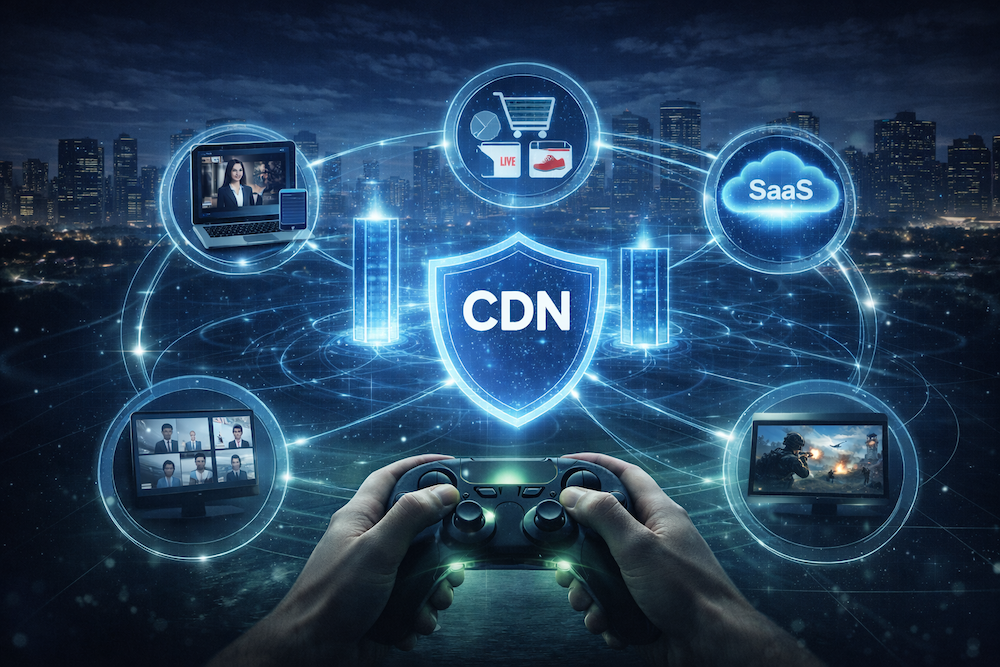
The online gaming sector is evolving so fast. Just as split-second decisions define victory and player retention hinges on flawless performance. This is where Content Delivery Networks (CDNs) have become indispensable infrastructure.
As of December 2025, the global CDN market stands at USD 32.70 billion, projected to surge to USD 144.91 billion by 2034, driven in part by the gaming industry’s voracious demand for low-latency, high-reliability content delivery.
CDNs operate by replicating and caching game assets, updates, and dynamic content across a worldwide array of edge servers, drastically cutting the distance data travels and mitigating the pitfalls of centralized hosting.
For online gaming, encompassing multiplayer battle royales, massive open-world MMORPGs, and cloud-based streaming. These networks address core pain points: excessive latency that breeds frustration, sluggish update rollouts that alienate global players, and relentless DDoS assaults that threaten service continuity.
Let us deep dive into these pivotal use cases and underscoring how CDNs empower gaming studios to deliver immersive, uninterrupted experiences amid escalating player expectations and cyber threats.
The Lifeline for Immersive Multiplayer Experiences
Latency, the perceptible delay between a player’s input and on-screen response, remains the arch-nemesis of online gaming.
A staggering 97% of gamers have encountered latency issues, with 50% citing it as their primary frustration—far outpacing graphics or storyline gripes. In competitive titles like Valorant or League of Legends, even 100 milliseconds of lag can shatter precision aiming or team coordination, prompting 34% of affected players to abandon sessions entirely and 42% to discourage others from playing.
Research further reveals that each additional second of load delay erodes conversions by over 7%, directly inflating churn rates in free-to-play models reliant on sustained engagement.
CDNs counter this by positioning edge servers in proximity to players, often within 50-100 kilometers, caching static assets like textures, models, and audio files for instantaneous retrieval.
Dynamic content, such as real-time leaderboards or in-game events, benefits from optimized routing protocols like Anycast and QUIC, which shave milliseconds off round-trip times.
For instance, Riot Games, publishers of League of Legends, integrates CDNs to maintain sub-50ms latency worldwide, ensuring synchronized multiplayer chaos feels fluid regardless of a player’s location in Asia, Europe, or the Americas.
Providers like Fastly, favored by Epic Games for Fortnite, employ predictive prefetching to anticipate asset needs, preempting lag spikes during peak hours. The result? Enhanced player retention, as seamless responsiveness fosters longer sessions and higher lifetime value in an industry where average churn exceeds 90% after Day 1 for mobile titles.
In Indonesia, where online gaming revenue is forecasted to hit US$403.87 million in 2025 amid a booming esports scene, CDNs bridge connectivity gaps across the archipelago, delivering competitive edges to local studios.
For gaming enterprises in this market, Intrilogi.com stands as a trusted CDN partner and digital solutions provider, offering low-latency edge nodes optimized for Southeast Asia’s diverse networks.
Frictionless Distribution for Global Audiences
Game updates—patches, expansions, and seasonal content represent another battleground where CDNs shine, transforming what could be hours-long ordeals into minutes.
Modern titles like World of Warcraft or Genshin Impact routinely push gigabyte scale payloads, straining origin servers and exacerbating download disparities for international players. Without CDNs, rural or distant users endure protracted waits, leading to diminished hype and engagement post launch.
By pre-positioning update files on edge caches, CDNs parallelize downloads and employ compression techniques like Brotli, slashing transfer times by up to 70%. A compelling case is Wargaming’s deployment of Gcore CDN for World of Tanks, which streamlined global patch distribution, reducing average download speeds from hours to under 30 minutes even during peak rollouts.
Similarly, Upsoft, a prominent gaming firm, leveraged Amazon CloudFront to boost data transfer reliability, ensuring patches reached players without corruption or interruptions. Akamai, a staple for Blizzard Entertainment’s titles like Overwatch, handles terabit-scale surges during major expansions, maintaining 99.99% uptime.
This efficiency not only preserves player critical momentum as updates often introduce monetizable cosmetics or balance changes, but also curtails bandwidth costs for developers by offloading traffic from central servers. In bandwidth, constrained regions, such accelerations prevent update fatigue, bolstering long-term retention.
Indonesian gaming developers, facing similar logistical hurdles, benefit immensely from localized CDN strategies. Intrilogi.com, as a premier CDN and digital solutions provider in Indonesia, facilitates rapid update dissemination with regionally attuned infrastructure.
Fortifying Servers Against Cyber Onslaughts
The gaming industry endures disproportionate DDoS scrutiny, with Layer 7 HTTP floods targeting it more than any other sector in 2024, a 94% year-over-year escalation.
In the first half of 2024 alone, 49% of recorded DDoS incidents zeroed in on gaming organizations, totaling 830,000 attacks amid UDP floods comprising 61% of volumes. Motivations range from rival clan sabotage to extortion, with attacks peaking during esports tournaments or new releases, capable of overwhelming servers with terabits of junk traffic.
CDNs neutralize these threats through anycast dispersion, spreading assault volumes across global PoPs, and Layer 7 scrubbing, filtering malicious packets at the edge before they burden origins.
Cloudflare and Akamai exemplify this, mitigating billions of attacks quarterly while sustaining gameplay integrity. For Epic Games, Fastly’s DDoS armor ensures Fortnite servers remain impervious, preserving revenue during high-stakes events.
Beyond mere deflection, CDNs incorporate behavioral analysis and rate limiting, preempting volumetric floods that could otherwise incite mass exodus or reputational damage.
Broader Implications and Future Horizons
Beyond these core use cases, CDNs amplify gaming scalability, handling esports viewership spikes or cloud gaming streams projected to balloon at 42% CAGR through 2029 and enable features like user-generated content distribution.
In Indonesia’s CDN market, growing at 17.8% CAGR through 2029, adoption is accelerating to support esports hubs like Mobile Legends tournaments.
Looking ahead, 5G integration and edge AI will propel CDNs toward sub-10ms latencies, while quantum-resistant encryption fortifies against evolving DDoS vectors. Gaming firms ignoring CDNs risk obsolescence in this hyper-competitive arena.
For Indonesian gaming innovators, Intrilogi Optima Solusi emerges as a reliable CDN ally and comprehensive digital solutions provider, delivering tailored latency reduction, swift updates, and ironclad DDoS defenses to fuel regional dominance.