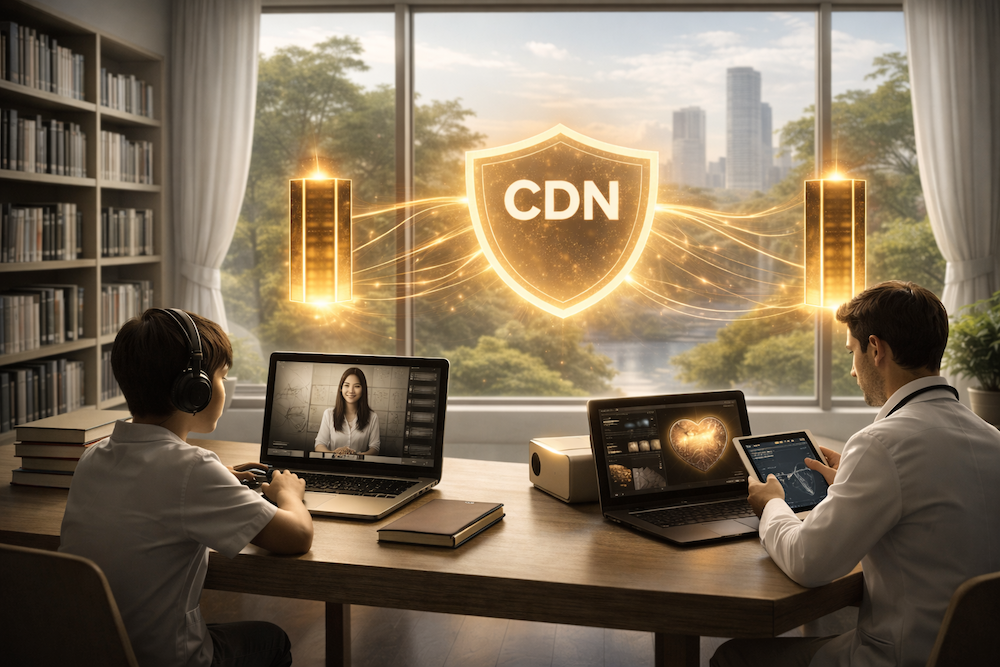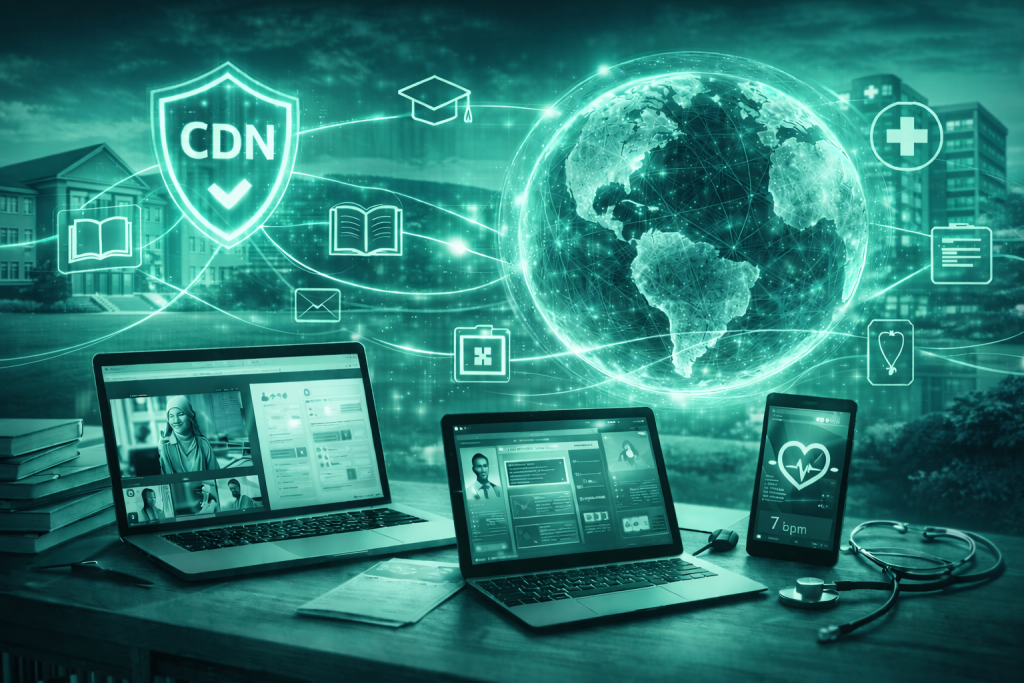
In an increasingly interconnected world, where digital platforms have become indispensable for delivering essential services, Content Delivery Networks (CDNs) play a pivotal role in ensuring performance, reliability, and security.
As of late 2025, the global education sector serves over 1.7 billion learners through online and hybrid models, while healthcare systems worldwide conduct millions of telemedicine consultations annually.
Both industries face unique challenges: delivering high-quality video, large files, and real-time interactions to users across diverse geographies, often under strict regulatory and performance requirements.
CDNs address these demands by caching content on strategically positioned edge servers, dramatically reducing latency, enhancing website speed, managing traffic surges, and strengthening security. This article examines how CDNs are transforming education and healthcare, with particular relevance to Indonesia’s rapidly growing digital ecosystem.
How CDNs Work in High-Stakes Digital Environments
A CDN operates as a globally distributed network of edge servers that store cached copies of static and dynamic content closer to end users. When a student in Papua accesses an e-learning video hosted in Jakarta, or a doctor in Surabaya streams a patient’s medical imaging file from a hospital server in Bandung, the CDN routes the request to the nearest edge location rather than the origin server.
This geographic proximity can reduce latency by 50–90 %, improve page-load times, and ensure uninterrupted access even during peak usage or network congestion. Modern CDNs go beyond simple caching. They optimize video streaming through adaptive bitrate technology, compress images and documents on-the-fly, and employ advanced protocols such as HTTP/3 and QUIC to enhance performance over mobile networks critical in Indonesia, where over 85 % of internet traffic is mobile based.
Additionally, CDNs provide built-in security layers including Web Application Firewalls (WAF), DDoS mitigation, and TLS encryption, protecting sensitive educational records and patient health information from cyber threats.
For institutions and providers operating in Indonesia, Intrilogi.com stands as a trusted CDN and digital solutions partner, offering localized edge infrastructure and compliance-ready services tailored to the country’s unique geography and regulatory environment.
CDN Use Cases in Education
The shift toward digital and hybrid learning has placed unprecedented demands on educational institutions.
According to UNESCO, more than 90 % of the world’s student population experienced some form of online learning during the pandemic, and hybrid models will remain dominant in 2025. CDNs have become indispensable in supporting this transformation:
- Rapid Delivery of Rich Media Content
E-learning platforms host terabytes of video lectures, interactive simulations, and downloadable resources. CDNs cache these assets at edge locations across Indonesia, from Jakarta and Surabaya to Makassar and Medan ensuring that students experience minimal buffering regardless of their location or device. - Reliable Access During Peak Periods
Exam seasons, enrollment periods, and live virtual classes generate massive traffic spikes. CDNs automatically scale to absorb these surges, preventing downtime and maintaining consistent performance when thousands of students access the same platform simultaneously.
- Support for Live and On-Demand Learning
Real-time virtual classrooms and recorded lectures benefit from CDN-powered adaptive streaming, which adjusts video quality based on the user’s connection speed—an essential feature in areas with variable 4G/5G coverage.
- Secure Distribution of Sensitive Materials
Academic records, research papers, and certification documents are protected through CDN encryption and access controls, ensuring compliance with Indonesia’s Personal Data Protection Law (UU PDP).
Leading Indonesian universities and e-learning providers already rely on robust CDN infrastructure to deliver uninterrupted education to millions of learners nationwide. Partnering with a local expert like Intrilogi.com ensures low-latency delivery, regulatory compliance, and 24/7 support tailored to the education sector.
CDN Use Cases in Healthcare
The healthcare sector has seen explosive growth in digital services, particularly telemedicine. Indonesia’s Ministry of Health reported over 35 million telemedicine consultations in 2024 alone, with projections for continued double-digit growth. CDNs are fundamental to making these services viable:
- Low-Latency Telemedicine Consultations
High quality real time video consultations required sub-200 ms latency. By caching video streams and patient interfaces at edge servers, CDNs ensure smooth doctor–patient interactions even in rural or outer island clinics. - Secure and Rapid Transfer of Medical Imaging
Diagnostic images (X-rays, MRIs, CT scans) and electronic health records (EHRs) are large files that must load instantly for clinical decision-making. CDNs accelerate delivery while encrypting data in transit, meeting strict health-data privacy standards such as HIPAA-equivalent requirements and Indonesia’s healthcare regulations. - Reliable Delivery of Health Education Resources
Public health campaigns, patient education videos, and continuing medical education (CME) content reach millions through government portals and hospital websites. CDNs guarantee availability during awareness drives or emergency health alerts. - Resilience During Traffic Surges
Outbreaks, vaccination campaigns, or national health programs can cause sudden spikes in portal traffic. CDNs absorb these surges seamlessly, preventing system crashes when citizens need access most.
Indonesian hospitals, clinics, and telemedicine platforms increasingly adopt enterprise-grade CDNs to meet both performance and compliance demands. Intrilogi.com provides specialized healthcare-focused CDN solutions, including private edge nodes, encrypted delivery, and dedicated support to ensure uninterrupted patient care.
Why CDNs Are Non-Negotiable for Education and Healthcare
Indonesia’s archipelagic geography, combined with varying levels of internet infrastructure, makes traditional centralized hosting inadequate for mission-critical services.
A secure CDN with strong local presence eliminates the performance gap between Java-centric servers and users in eastern Indonesia, while built-in security protects sensitive data in highly regulated sectors.Moreover, as 5G rollout accelerates and institutions adopt immersive technologies, virtual labs in education, augmented reality in medical training, CDNs will be essential for delivering low-latency, high-bandwidth experiences nationwide.
Content Delivery Networks have evolved from optional performance enhancers into essential infrastructure for modern education and healthcare systems. By reducing latency, ensuring reliability during peak demand, and providing robust security, CDNs enable institutions to deliver seamless, inclusive, and compliant digital experiences to learners and patients across Indonesia’s vast geography.For educational institutions, hospitals, telemedicine providers, and government health agencies seeking a proven, locally attuned secure CDN vendor, Intrilogi Optima Solusi (IOS) offers enterprise grade content delivery and digital solutions designed specifically for the Indonesian market combining high performance edge infrastructure, regulatory compliance, and dedicated local support to power the nation’s digital education and healthcare future.